
Dojo Tango: Two AI Models Review Each Other's Code Before You Ship
Code review tools are everywhere this week. Dojo Tango puts two AI teammates, ideally on different models, in a scored review loop until the change earns a 5/5. Then the same workspace opens the PR, and also edits video, makes images, speaks, and browses.
Code review tools are everywhere this week. That is a good thing: a second pair of eyes catches what the author cannot see.
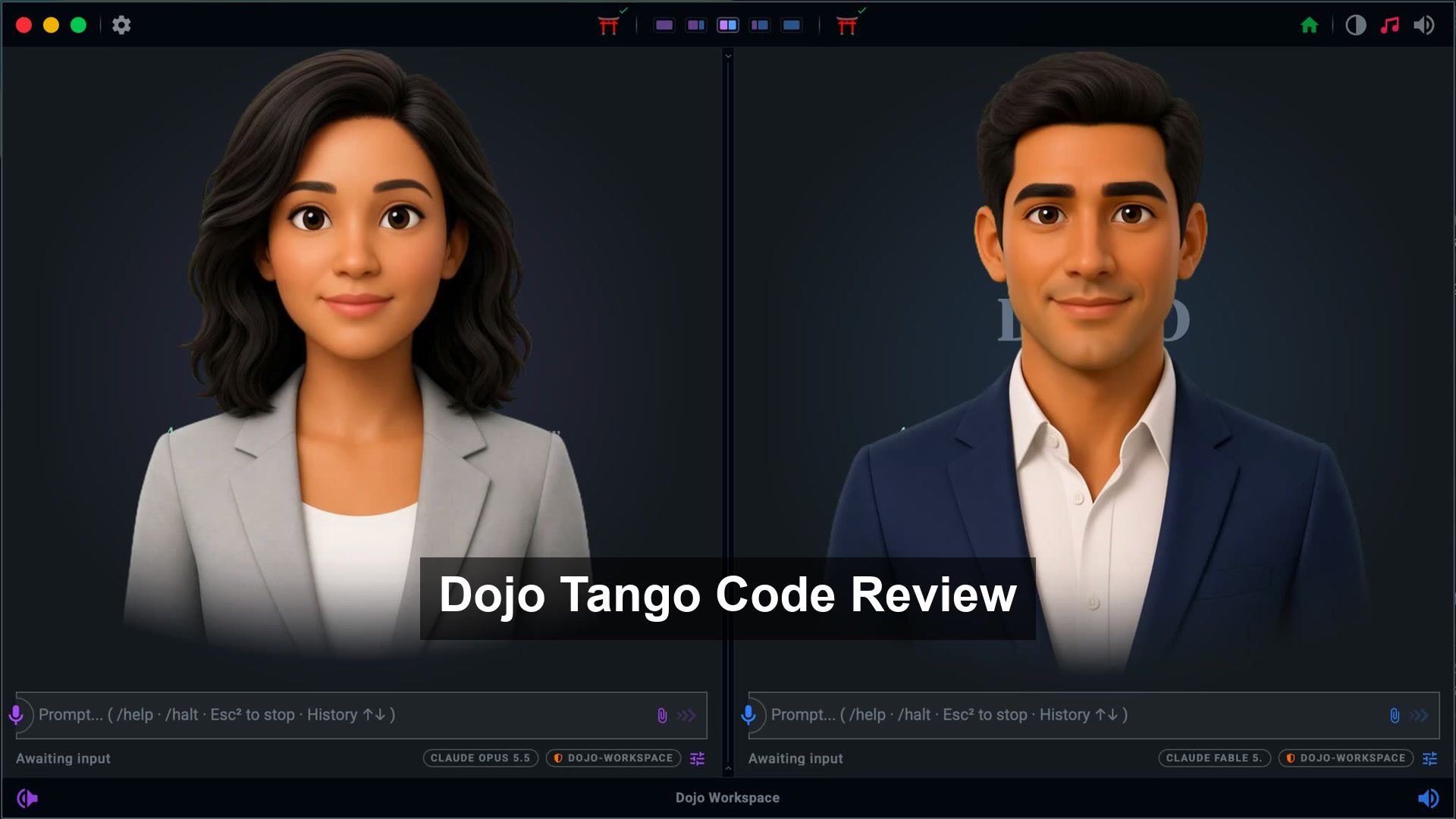
In Dojo, that second pair of eyes has been part of the workspace for a while. We call it Tango. Two AI teammates sit side by side: Dojo Solo on the left and Dojo Duo on the right. One writes the change, the other reviews it, and they go back and forth until the work earns a 5 out of 5.
The difference is that the reviewer is not a separate product. It sits in the same workspace that writes the code, opens the pull request, edits the launch video, makes the images, and reads the result back to you out loud.
Press play to watch a real session, then read on for how a tango round works.
Why two different models
A model reviewing its own work tends to agree with itself. The blind spots that produced a bug are often the same ones that miss it in review.
Tango works best when the two lanes run different models from different providers. One might be strong at careful reasoning, the other at spotting edge cases. You bring the providers you already use; Dojo makes them work as a team.
If both lanes happen to run the same model, Tango still works. A fresh lane with no shared context is still an independent reader. But two different minds is the point.
How a tango round works
| Step | Who | What happens |
|---|---|---|
| 1. Get it ready | Owner | Finishes the change, runs format, type-check, lint, and the tests that cover it, fixes failures, and commits |
| 2. Ask for review | Owner | Sends the exact commit range, what changed and why, the check results, and the risks worth hunting |
| 3. Review | Reviewer | Reads the diff and the code around it. Returns a score out of 5 and findings as file:line, severity, issue, fix, marks which are blocking, and says what would make it a 5 |
| 4. Respond | Owner | Weighs each finding on its evidence. Fixes what holds up, explains what doesn't, and commits the fixes as a new commit. History is never rewritten |
| 5. Repeat | Both | New commit range, new round, until it scores 5/5 or only real product decisions are left |
Those remaining decisions come back to you. The reviewer can raise a product question. It does not get to settle it.
The rules that keep it honest
- The reviewer stays read-only. It reads; it does not quietly patch the code it is judging.
- No double work. The owner already ran the checks, so the reviewer focuses on correctness, logic, edge cases, architecture, and missed requirements instead of rerunning the test suite. If you want independent validation, ask and it will run them too.
- Evidence beats confidence. When the two lanes disagree, the argument is settled by a focused check, not by which lane sounds surer or answered first.
- Every finding gets an answer. Fixed (with the commit), declined (with a reason), or handed to you as a decision. Nothing just disappears.
- You are not the messenger. The lanes talk to each other directly. You never copy-paste a review from one window into another.
- Your rules win. Want hooks on, tests rerun by the reviewer, or a stop at 4/5? Say so, and it carries into every round.
From 5/5 to pull request
When the review lands at 5/5, the same lane that did the work opens the pull request. Dojo tidies the branch, runs the full validation once, and creates the PR with the summary already written.
There is no hand-off to another tool, so nothing is lost between "the review said it's fine" and "the PR says what changed."
One tool does it all
Tango is one feature. The same workspace, the same conversation, and the same providers also cover:
| 💻 Code | Writing, debugging, refactoring, local search by meaning, code review, pull requests |
| 🎬 Video | Trimming, joining, title cards, conversion, AI video generation and edits |
| 🖼️ Images | Creation, edits, product shots, try-on |
| 🎙️ Voice and audio | Spoken replies, narration, music, transcription |
| 🌐 Browser | Automation, research, verified multi-step runs |
| 📊 Visuals | Diagrams, charts, and equations rendered inline |
You do not need one subscription for review, another for video, and a third for voice. You need one workspace and the AI providers you already trust.
Behind the scenes: this post made itself
The video above was finished in Dojo, in the same session that wrote this post.
- The title card. The original screenshot was 2048×1155, three pixels taller than true 16:9. Dojo trimmed those three pixels, scaled it to 1080p, and added the Dojo Tango Code Review title in the lower third, placed just above the two prompt boxes. The header image of this post is a frame from that card.
- The bookends. The three-second card goes at both the start and the end of the session recording.
- An honest mistake, then the fix. The first join re-encoded the entire eight-minute recording, which was slow and unnecessary, and the audio came out wrong. Val flagged it. Dojo re-rendered only the three-second title card to match the recording's exact codec, frame rate, colour settings, timebase, and audio format, then joined the three pieces as a straight stream copy. The original picture and sound went through untouched. Dojo then decoded the whole file end to end and confirmed audio and video line up to within about 21 milliseconds.
- The copy. The LinkedIn, YouTube, and X posts, and this article, were drafted in the same conversation. The media was uploaded through Dojo's portal connection.
That third point is the same spirit as Tango: make the change, get challenged, fix the cause, and check the real result.
Try a tango
Open both panels, give each lane a model (different providers if you can), and tell the lane doing the work: "tango with Duo." Dojo handles the rounds, the commits, the scores, and the PR.
If you want the bigger picture of why a second lane matters, read our earlier post, One Builds. Another Challenges.
One workspace. Two minds. Better code.
Try it at heydojo.ai.