
Find the Needle, Not the Haystack: Dojo Searches Video by Meaning, on Your Own Computer
A red cross, a yellow number 11 jersey, a gunshot, a woman punching a burglar. Two Dojo teammates hunted moments across two TV episodes and a full movie by describing them in plain words. The search ran on the computer itself: no tags, no timestamps, no footage uploaded.
Everyone has been there: you need one moment buried in hours of video. A logo on a shirt, a jersey number, a gunshot, the scene where somebody finally gets what they deserve. So you scrub. And scrub. And scrub.
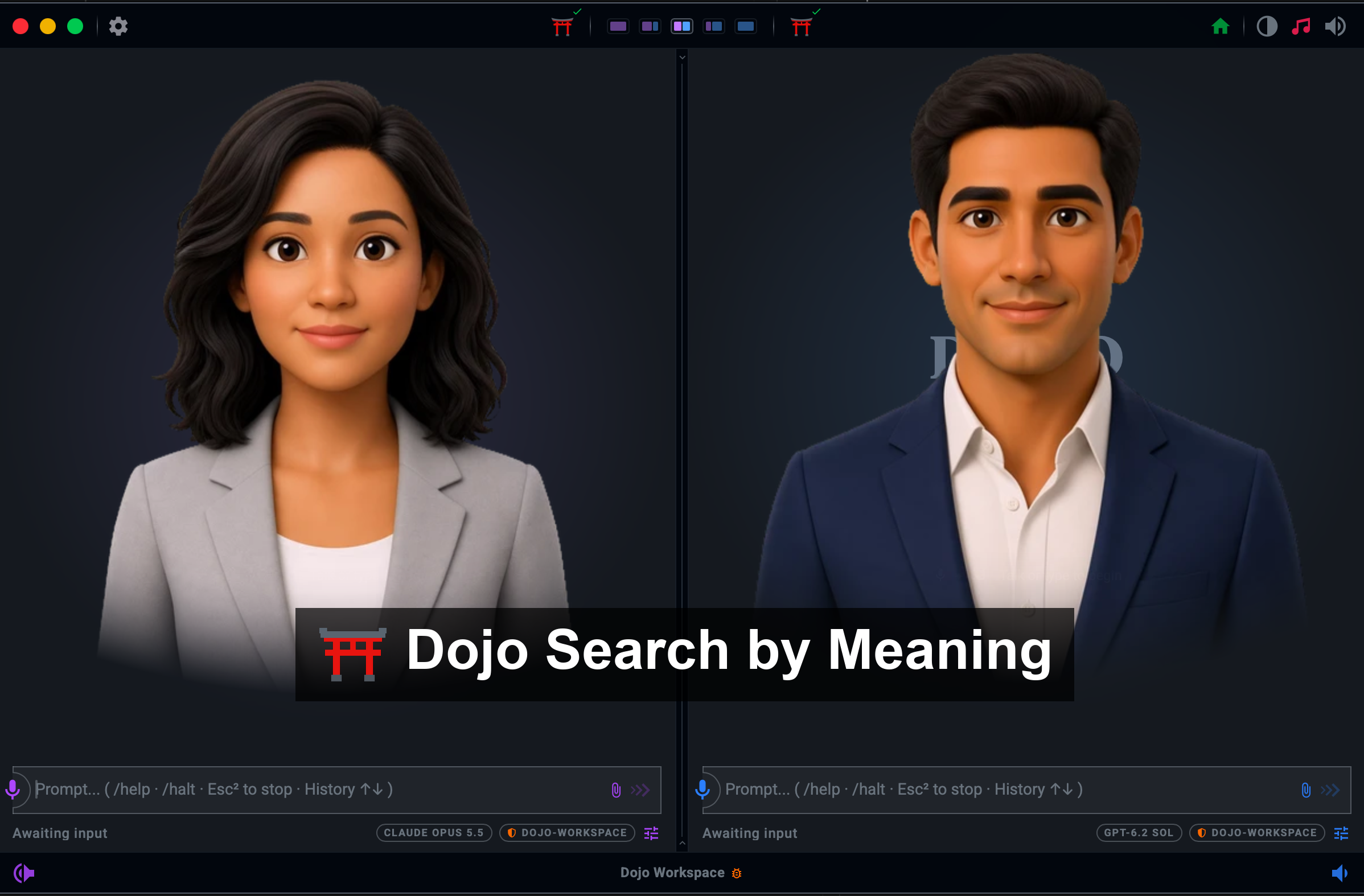
In this session we stopped scrubbing. We gave Dojo three videos and simply described what we wanted in plain words. No tags, no timestamps, no metadata, no one had labelled anything. Dojo found the moments and opened each one, paused on the exact frame.
The part we're proudest of: the search itself ran on the computer. The footage never left the machine.
The setup: a director and a searcher
Dojo Workspace can run two AI teammates side by side. For this session:
- Ava, on Dojo Solo, was the director. She never searched herself. She turned each request into a clear brief: which file, what to look for, what to ignore, the deadline, and how to report back. Then she checked the answers.
- Sam, on Dojo Duo, was the searcher. He ran the searches, checked the best hits, pinned down the moment frame by frame, and opened it in Preview.
They talk to each other through Lane Assist, Dojo's built-in way for one lane to hand work to the other. Here the two lanes ran on different models, Claude Opus 5.5 and GPT-6.2 Sol, which is exactly the point: a second, independent mind checking the first.
How searching by meaning works
An on-device model looks at frames from the video, about one every second or two, and ranks them by meaning, not by keywords. Ask for shoes hanging around a man's neck and it finds shoes hanging around a man's neck, even though nothing in the video is labelled that way.
The first search on a new video builds an index on the computer's GPU. Every search after that reuses it and comes back almost instantly.
Sam reads the top 12 hits on a single contact sheet, picks the right one, narrows in second by second when it matters, and opens the video paused on the match. For sounds, a separate on-device model listens to the actual audio in five-second windows, so a gunshot means the sound of a gunshot, not the word.
The hunt, moment by moment
We didn't tell Sam the names of the videos. You'll recognize them.
| Request | Video | What Sam found |
|---|---|---|
| The first red cross | Friends | 7:42. A big red cross on Rachel's white long-sleeve top in Monica's apartment. He also checked everything before it: the theatre crowd, the opening credits, backstage. The red in those shots was coats and a shawl. |
| The first Central Perk scene, in under a minute | Friends | 4:24. It opens on the café through the front window, then cuts inside to the orange couch. Found well inside the minute. |
| The first yellow jersey with the number 11 | Modern Family | 8:08. Under a minute, even though this episode had never been indexed. The weaker matches were yellow plaid shirts and yellow walls, not jerseys. |
| A man smacking chicken breasts in a kitchen | Modern Family | 9:52. Jay pounding raw chicken. Sam searched by picture and by sound together: the visual hits and the audio thuds lined up. |
| Two men kissing | Modern Family | 17:58. Mitchell gives Cam a quick peck on the couch. Asked for any other pair, Sam said honestly that he couldn't find one, and offered his best unconfirmed guess. |
| A man wearing shoes around his neck | Modern Family | 12:42. Jay walks through a doorway with brown shoes hanging on his chest. |
| Kevin's first scene in Central Park | Home Alone 2 | About 24:12. Kevin, small in the shot, in his green coat with the yellow hood. This was a full movie that had never been indexed, and the whole job ran in about three minutes. |
| The first gunshot | Home Alone 2 | About 35:10, found by sound alone. It's the old black-and-white gangster movie on the TV in Kevin's hotel room: pretend gunfire, not a real shot. |
| A woman punching one of the burglars | Home Alone 2 | 58:30. This one took a human. See below. |
The best moment: when the trail went cold
The punch was the hardest request. Sam searched the whole movie and came back without a confirmed answer. His best guess, at about 53 minutes, showed the two burglars wincing on a street, but no woman in the frame. He said so plainly and marked it unconfirmed instead of pretending.
Then Val added a hint: it happens when the burglars grab Kevin by the shoulders. Ava turned that into a new brief. Sam found the grab, went through it frame by frame, and there it was: at 58:30 a blonde woman in a black coat swings at Harry, and her fist lands at 58:35. Kevin breaks free and runs past a hot dog cart.
Ava corrected herself too. She had told Sam the scene was probably at night. That was her own guess, not something Val said, and the scene is actually in daylight.
That's the real lesson: people and semantic search work best together. The model narrows hours to seconds. A person's hint can crack what the model alone can't.
Honest about the limits
Good search tools tell you where they might be wrong. Sam did, every time:
- Sampling. Frames are checked every one to two seconds, so a flash shorter than that could be missed. When it mattered, Sam re-checked second by second.
- Top hits, not everything. A search shows its 12 best matches, so a quieter or smaller earlier occurrence could rank lower. For first appearance requests, Sam searched the stretch before his answer separately.
- Sound means sound. Audio search finds what things sound like, not what people say. Searching dialogue means transcribing the speech first, which Dojo also does locally, as a separate step.
- It finds; you confirm. Dojo can't hear the clip the way you do. That's why every result opens in Preview, paused on the moment, for a quick play.
Who this is for
Anywhere the job is finding a needle in a haystack of footage, in minutes instead of hours:
- Newsrooms and film archives: pulling the shot you need out of years of footage that was never tagged.
- Editors and creators: finding the take, the reaction, the B-roll, or the sound cue without logging everything first.
- Sports: finding highlights, a jersey number, a celebration, the moment the crowd erupts.
- Security review: going through hours of recordings for a person, a vehicle, or an event.
- Wildlife and research recordings: finding the animal, the behaviour, or the call in long unattended footage.
- Legal evidence review: locating moments in large volumes of video and audio, with timestamps you can go back to and verify.
- Teachers: pulling the perfect clip for a lesson out of a full film or episode.
- Long-footage review of games, production lines, and events, where the moment that matters is a few seconds out of hours.
Why on-device instead of the cloud
Cloud video-intelligence services can do impressive things. They also ask you to upload your footage first. For a lot of the work above, that is exactly the problem.
| Cloud video search | Dojo search by meaning | |
|---|---|---|
| Where your footage goes | Uploaded to someone else's servers | Stays on your computer |
| Sensitive material (evidence, security, unreleased cuts, private recordings) | Needs approvals, contracts, and trust in a third party | Never leaves the machine you already control |
| Getting started | Upload hours of video before the first search | Drop the file in and ask |
| Cost | Typically billed per minute of video, every time you index | Runs on the GPU you already own; indexing happens once per file |
| Repeat searches | Often another processing pass | Near-instant on an indexed file |
| How you ask | Labels, APIs, or a fixed set of categories | Plain words, in conversation |
| What happens next | Export results to another tool | The same workspace can trim, cut, transcribe, and publish |
To be precise about what is local: the visual and audio search models run on the device, and so do indexing, frame checks, transcription, and video editing. The conversation with Ava and Sam uses whichever AI provider you connect to Dojo, and you choose which one.
And search is only the start. In the same Dojo session that produced this post, the editor cut, the frame-accurate trims, speeding up the silent stretches, the transcript, and the upload to this blog all happened in one place.
Try it
Install the on-device image and audio search models from Settings, drop in a video, and describe what you're looking for. If you've ever lost an afternoon scrubbing a timeline, start with that one.
They power AI. We empower you.
Get Dojo at heydojo.ai, then press play on the session above.